
USA vs. Canada for Gold Again as Rivals Look to Close U18 WWC with One to Build On
By Scott Lowe – MYHockeyRankings.com
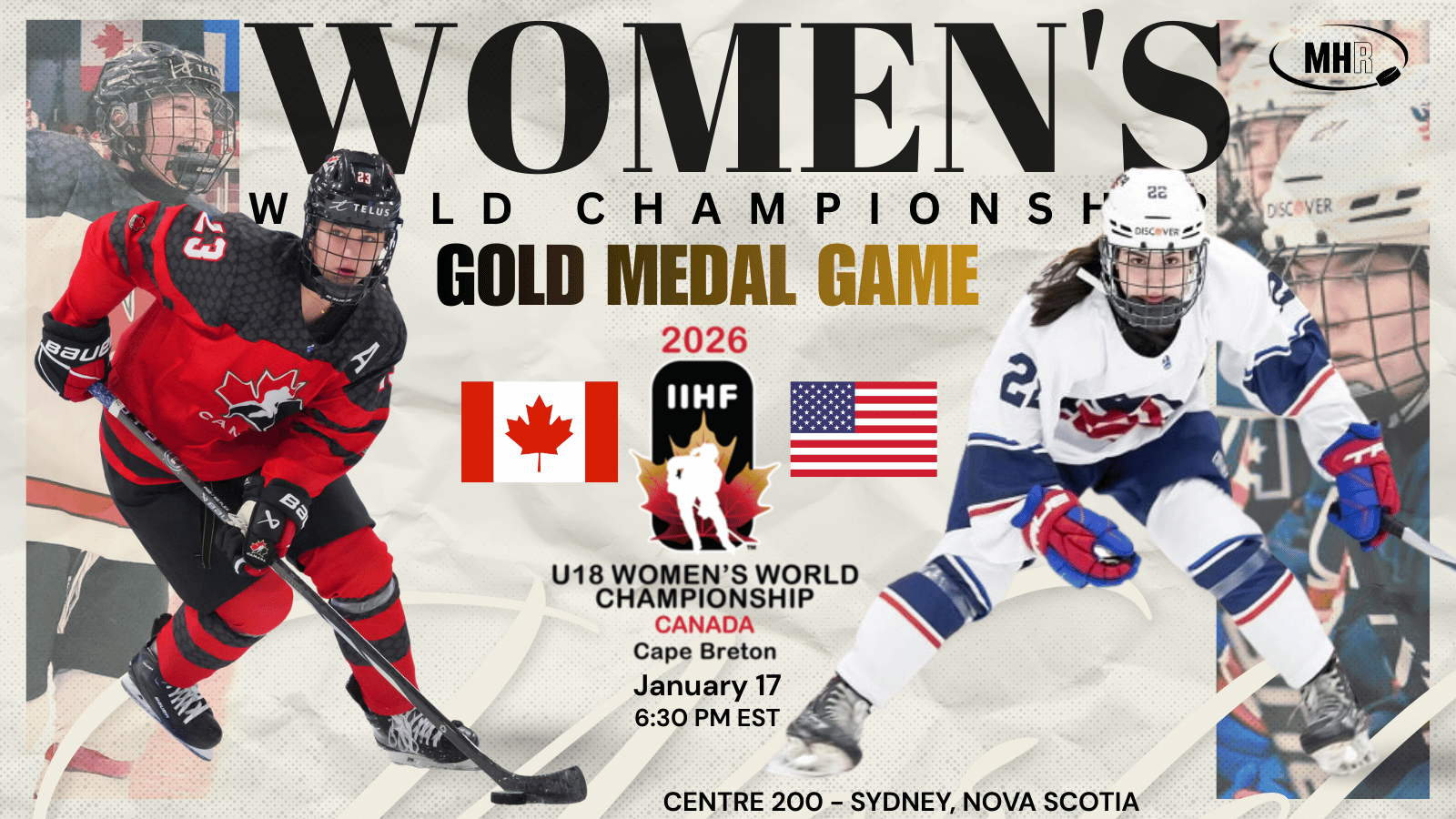
As if scripted, the United States plays Canada Sunday evening for the gold medal at the 2026 Under-18 Women’s World Championship in Nova Scotia.
Again.
It’s fortunate for the International Ice Hockey Federation that because of the women’s hockey world order, any tournament the organization runs almost is guaranteed to feature a matchup of the world’s two hockey superpowers.
This year’s final marks the 15th time in 18 tournaments since the first U18 WWC in 2008 that the U.S. and Canada will meet for the gold medal. One of the North American nations has won the tournament every year, with Sweden earning two silver medals and Czechia one. Canada has failed to advance to the gold-medal game twice, most recently in 2024, while the United States missed it only after falling to Sweden in the 2023 semifinals.
Each time that happened prior to 2024, however, the tournament’s format ensured that the two nations met in the preliminary round. As nations such as Sweden, Finland and Czechia continued to become more competitive on the international women’s hockey stage, the IIHF decided to shift to a more traditional format by placing the U.S. and Canada in opposite pools, ensuring they would not meet until one of the playoff rounds.
This was a positive sign for women’s hockey, indicative of the sport becoming more competitive around the world, and back-to-back gold-medal games that didn’t include both North American teams seemed to support that decision. Those indicators, along with the creation and success of the Professional Women’s Hockey League in North America, provided evidence that the level of play was on the rise globally and the most competitive international tournaments ever might be right around the corner.
While the growth signs still are extremely encouraging, the belief that other nations with women’s hockey programs were ready to challenge the North Americans for international world prominence consistently was a tad premature.
A look at recent history for the senior Women’s World Championship shows that the United States and Canada have met for the gold medal five straight years since Finland’s 2019 semifinal upset of Canada and heartbreaking championship-game lost to the United States. That remains the only time in 24 Women’s World Championship tournaments that the gold-medal game didn’t involve the two North American rivals.
Russia, which has captured three WWC bronze medals, being suspended from international play has hurt the overall competitive level for sure, but the emergence of Finland and Czechia as legitimate medal contenders that are good enough to occasionally beat one of the superpowers has been encouraging. History also has shown that Switzerland and Sweden are capable of building and sustaining competitive programs.
The existence and success of the PWHL has lured more Europeans to compete in the league each year, which will aid in the continued development of those players and others who make that leap in the future. By default, more international players in the PWHL training with and ccompeting against the world’s best for six or seven months annually should raise the level of play around the world.
It’s an exciting time for women’s hockey, and the future is brighter than ever, but it’s important to understand that the process of globalizing the sport requires time and patience. That is readily apparent given women’s hockey’s recent trajectory at the international level.
Given the format change of the U18 WWC and the results in 2023 and 2024, expectations for the most competitive tournament ever were high heading into the 2025 event in Finland. The early returns last year were a bit disappointing, however.
Team USA opened the 2025 U18 WWC by going 3-0-0 in pool play while outscoring its opponents, 14-0, to earn the top quarterfinal seed. Canada also went unbeaten and outscored its foes, 16-3, earning the second seed. The Canadians then handed Japan an embarrassing 17-0 quarterfinal setback, with the U.S. beating Slovakia, 9-1.
It was total North American dominance to that point, much to the chagrin of many who expected a more competitive event. The two teams had outscored their opponents by a combined 56-4 in eight games, and all signs pointed to another epic USA vs. Canada gold-medal tilt.
And that’s exactly what we got, but it didn’t happen without a fight.
The U.S. scored a power-play goal midway through the second period and held off Sweden thanks in part to a 35-18 shots-on-goal advantage for a 2-1 semifinal victory. Meanwhile, Canada fell behind against Czechia with 7:26 left in the first period of its semifinal and scored three straight times in the middle frame before Czechia cut the margin to one entering the final 20 minutes. Hayley McDonald potted an insurance goal with 7:53 remaining to lift the Canadians into the gold-medal game.
Canada captured its eighth U18 WWC gold medal with a 3-0 victory, thwarting Team USA’s attempt to earn a 10th gold.
Sweden and Czechia’s strong semifinal showings once again had international hockey fans hopeful that the momentum from the 2025 playoff round would carry over into a more competitive 2026 U18 WWC in Cape Breton, Nova Scotia.
Those folks were left disappointed again, however, as the North Americans have rolled through their opponents to date by even more impressive totals than they did a year ago. But this time that dominance continued all the way to and through the medal round.
Canada and the United States face off for the 2026 U18 Women’s World Championship gold medal Sunday at 6:30 p.m. EST at Centre 200 in Sydney, Nova Scotia. The game can be seen on TSN in Canada and NHL Network in the U.S. Sweden faced Czechia at 2:30 p.m. EST in the bronze-medal game.
“This is where we want to be,” Team USA Coach Courtney Kennedy said following her team’s semifinal win. “It’s exciting to get the opportunity to play for the medal we want.”
The Canadians compiled a 32-2 goal differential in three preliminary-round victories, including victories of 9-0 against Switzerland, 14-0 vs. Hungary and 9-2 over Sweden. Team USA, on the other hand, beat Finland, 14-0, Slovakia, 13-0, and Czechia, 9-1, for an overall scoring margin of 36-1.
The Americans then beat Hungary and Sweden by a combined 18-1 to advance to the gold-medal game, while Canada hammered Finland, 12-0, and Czechia, 8-1.
There would be no Cinderella this year in Nova Scotia.
Perhaps the most concerning performance of the 2026 U18 WWC was turned in by Finland, which seemed to be emerging as a legitimate world women’s hockey power not long ago. Finland went 0-3-0 in pool play and was outscored by 25 goals before losing to Hungary, 7-5, and suffering relegation for the first time in tournament history. Finland’s senior national team still is ranked third in the world heading into next month’s Winter Olympics in Italy, but how will the nation bridge that gap and prevent a massive fall off in performance going forward?
The good news is that the hockey world will be treated to another gold-medal showdown between bitter North American rivals, but the showing by other nations at this year’s U18 WWC makes it fair to suggest that it might be in the best interest of this event for the IIHF to return to a format that guarantees two games between the world’s unquestioned top two nations.
It’s hard to glean much from the tournament statistics in previewing the gold-medal matchup, but veteran Team USA goaltender Morgan Stickney, a Penn State commit from Shattuck-St. Mary’s, has yet to allow a goal in two appearances while setting the tournament career record for shutouts with five in two years. Playing in her second championship, 16-year-old Jane Daley has established a U18 WWC single-tournament record with 12 goals. Also from Shattuck, Daley is committed to Ohio State. Kylie Amelkovich, another Penn State Commit from Shattuck, has 12 assists, one short of Amanda Kessel’s all-time record.
The United States has an opportunity to become the first nation in tournament history to never trail in a game nor allow an even-strength goal. Canada, on the other hand, has outscored its five opponents by a 52-2 margin after falling behind, 1-0, in the opening game vs. Sweden. The Canadians also have a perfect netminder in Rowan Houweling, who plays for – you guessed it – Shattuck-St. Mary’s. She has posted two shutouts and was the backup behind Lea-Rose Charrois in the semifinals. Charrois became the first goalie ever to record two assists in a single tournament with her helper in the semifinals vs. Czechia.
Adrianna Milani has tied Canada’s single-tourney record with 10 goals, good for second in the tournament. Sofia Ismael has 15 points, one behind Chloe Primerano for Canada’s all-time single-tournament mark. Milani and Ismael both play for Canada’s top-ranked U22 Etobicoke Dolphins.
From a team standpoint, Canada has scored on 19 percent of its shots, tops in the tournament and less than one percentage point better than the U.S. Both teams have 11 power-play goals, but the Americans lead the field with a 52.38-percent success rate, compared to Canada’s 42.31-percent mark. Canada is a perfect 8-for-8 killing penalties, while the US has gone 16-for-18 with the player disadvantage.
"We spoke in the beginning about getting better every day," Team Canada Coach Vicky Sunohara said. "It's always challenging, bringing a group together that has never played together. But we've learned and we've grown, so we're excited now."
And we are just as excited to watch yet another epic North American rivalry game for all the marbles.